
In July 2022, I stepped off the train in Innsbruck, Austria, during a six-week backpacking trip. I stared at the spiny, massive mountains over the arch that guards the Old Town. I turned to my brother and said, “I’m going to live here someday.”
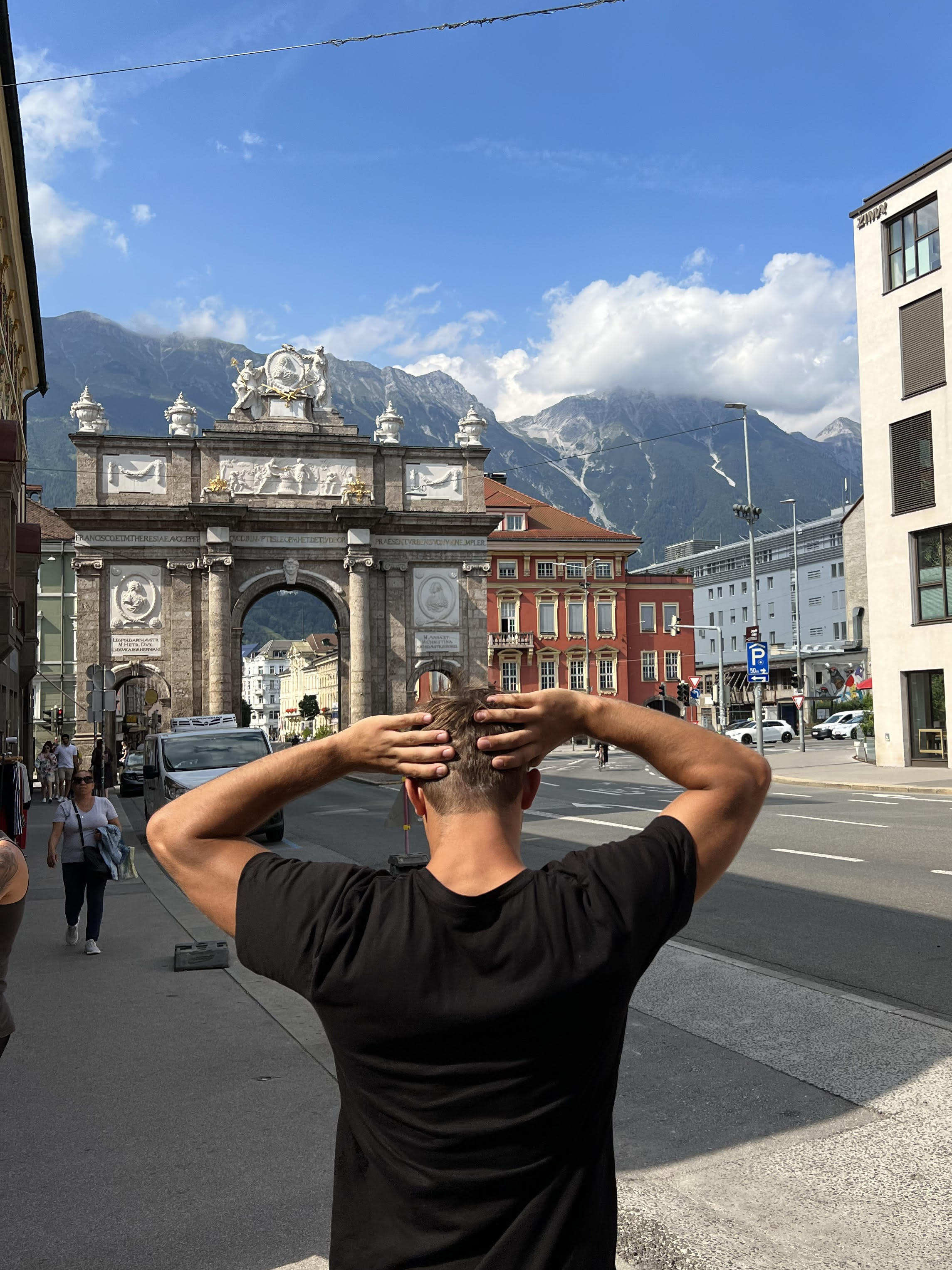
A pic of the arch and the mountains from my first time in Innsbruck.
That day came later than I thought. My sister’s wedding and a chance to ski in Utah all winter delayed the trip, but finally, in August of 2024, I moved to Innsbruck.
My three months in Innsbruck have been some of the best months of my life. Had I not been limited by my visa, I’d still be there.
Innsbruck is popular among hardcore outdoor enthusiasts, but I don’t know how it isn’t more famous. If you’re looking for a combination of city and access to nature, it’s the best place I’ve ever been. Surrounded by the Austrian Alps, you can take a bus from downtime and be at the base of towering, 3,000-meter mountains in 30 minutes.
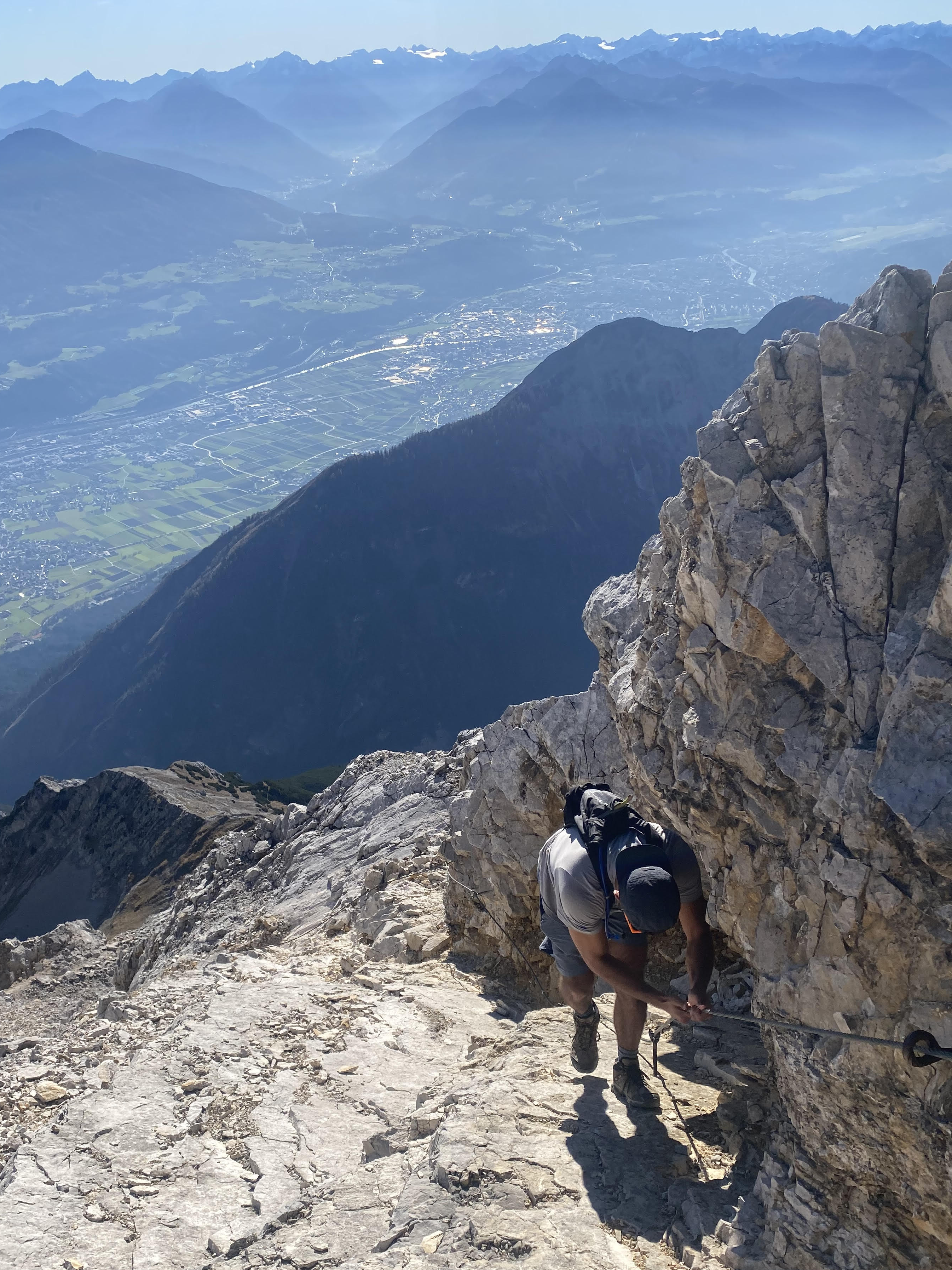
Descending one of the mountains around Innsbruck
When I got back to America, I decided to write this post to outline my time in Innsbruck and provide recommendations for anyone else looking to do the same.
Note: The first section of this post talks about lessons learned and some of my experiences in Innsbruck. If you just want to learn about tips for living in Innsbruck, feel free to skip around to section 2 “Practical Tips for Living and Working Remotely in Innsbruck.“
Lessons from Being a Digital Nomad
Let’s start by addressing something near and dear to my heart. I hate the term “Digital Nomad.” More specifically, I hate the stereotype surrounding it. When I think of a “Digital Nomad,” I think of an American working for Meta who goes around the world, rents an expensive Airbnb for two weeks at a time, learns how to say “hi” in the native language, and then moves somewhere else.
That is a judgmental take, seeing as I’m an American working in tech. But what really irks me about the stereotypical “Digital Nomad” experience is that it’s surface traveling. It’s traveling for Instagram stories, never staying long enough to make meaningful connections or experiences. Two-week trips are fun; two-month trips are impactful, and two-year trips are life-changing. There’s a reason that you’re so sick of hearing that one friend rave about their time studying abroad – it’s because they had enough time to actually experience society in another country and form meaningful connections, and it still affects them today.
If you have the privilege of working remotely internationally, here is how I would do it (and how I did it in Innsbruck).
1. Live with natives. Or at least, live with people from another country.
Living with people from multiple countries is much more common in Europe than it is in America, and it is essential to experiencing society abroad.
The easiest way to do this is to already know somebody in the area. Maybe they have a spare room in their house or know a friend of a friend who is subleasing for a few months. Another possible way to find roommates is through housing exchanges.
Before I moved to Innsbruck, I didn’t know anyone there. Luckily, I ended up sitting on a plane next to a guy from Innsbruck while flying from Guatemala to Costa Rica in 2023. I told him I wanted to live there soon, and he directed me to a few housing exchange websites. One of them, ÖH Wohnen, had many undergrad and graduate students posting subleases.
Starting in June of 2024, I looked for any post advertising a furnished room in the fall. After sending ~20 emails, a German girl named Juli finally responded. She had an internship from August to December and was looking to rent out her furnished room in a three-bedroom apartment. She had two roommates who would be living there as well, both around my age. After a 20-minute Zoom call, she concluded that I wasn’t a total weirdo and we started planning for my move in August.
I had no idea if I would like or get along with her roommates. But I knew that living with strangers from another country who knew people and knew the area would make for unique experiences. That’s more than enough to set yourself up well for a few months abroad, and a zillion times more interesting than living alone in an Airbnb.
2. Stay long enough to form relationships.
Places are cool. People are better.
I hate that I’m admitting that. Being a bit of an introvert, I battled my Mom (a sports psychologist) for years on the importance of relationships. It took until University for me to realize how much the people you’re with affect your experiences.
Fortuned favored me when it selected my Innsbruck roommates. They welcomed me into their social circles from week one. It’s rare to connect with a group of people so quickly, and it’s one of the reasons I felt so at home.

Me and some friends at the Bettelwurfhutte while hiking Große Bettelwurf
Living somewhere for more than a few weeks is a risk. What if you don’t meet anyone? What if you don’t make friends? It has the potential to be lonely. Reduce that risk by being open-minded and putting yourself in a position to form relationships, either by living with people, or knowing people in the area.
3. Live how they live.
If you’re going to a European city as an American, please don’t rent a car. Don’t call Ubers, or make peanut butter and jelly sandwiches. I love all of those things but try to adapt your lifestyle to the place you are going (at least for a short amount of time). If everyone in your city takes the subway, take the subway. If they eat a certain type of food, eat that food. At least try it their way, and if you hate it, you can always go back to American-style.
Innsbruck is a small enough city that most people walk, bike, or take the bus. When I got there, I was taking the bus, but the area was too beautiful not to be outside as much as possible. So, I hopped on Facebook marketplace and bought a bicycle for 80 euros. It was garbage, but absolutely worth it.

Long live the Mongoose.
I solely used public transportation in Innsbruck, even when going to the mountains. Twice I ended up semi-stranded in the mountains pretty far away from the city, and twice I was able to hitchhike my way back.
Two lessons I’ll be taking home with me from “Living how they live”– don’t be afraid of hitchhiking, and biking is >>>.
4. Discipline, and lack thereof.
This is a bit more of a philosophical rant than practical nomad advice, but it is probably the most important thing that has helped me enjoy living abroad.
Working remotely in a foreign country is a constant battle of when to be disciplined and when to enjoy the moment. I enjoy my job and care a lot about doing well. But what happens when your roommate invites you to go skiing on a Wednesday afternoon at a nearby glacier? Do you say no because you have to work?
Many people think discipline = boring. I think, counterintuitively, discipline is essential to being spontaneous. It is discipline that allows you to be spontaneous.
By minimizing distractions while working and efficiently using your free time to get ahead, you can put yourself in a position to say yes to last-minute plans, even if they’re during the week.
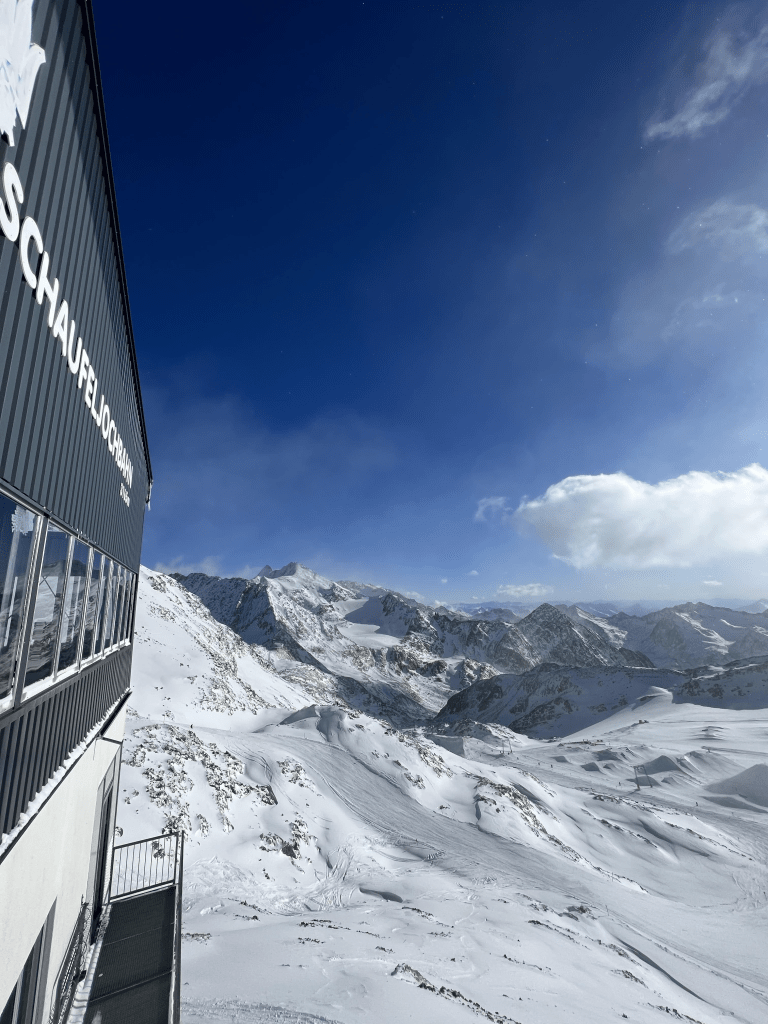
If you do it right, you can end up skiing at Stubai on a random weekday.
5. If you’re working American hours in Europe, get up early.
One of the most common questions I got while I was abroad was “What is it like working American hours in Europe?”
Technically, I work US central hours, which is ~3PM-12PM Central European Time. My work is a bit flexible, so usually I was able to shift that to ~Noon-9PM. But this meant my free time was in the morning, so if I wanted to do stuff in daylight, I had to get up and out.
I made sure to be out of the house by 9AM. Well, most of the time. I’d go for a run, bike ride, hike, workout, or just chill at a coffee shop – something to enjoy living in this new area. Then, by 12/1, I’d get to work, and once I was done I would hang out and cook dinner with my roommates.
Side note: I actually really enjoyed this work schedule. Starting at Noon meant I had three/four hours of uninterrupted focus time before anyone got online and the distractions began. I was amazingly more productive during this time than during normal work hours. Now that I’m back in the US, I’d love to recreate that, but that would mean waking up at 4am every day….we’ll see how that goes.
6. Don’t set expectations.
Every time I travel somewhere for a longer (>1 month) period of time, I’m taking a risk. Sometimes, my trips fall below my expectations, like the few weeks that I spent backpacking in Italy. I have no idea what traveling somewhere for a long period will be like, and that is exciting.
Rarely has any travel “lived up to my expectations”. Sometimes it’s been better than what I was expecting, sometimes worse, but always different. Don’t let what you think should happen keep you from enjoying what is actually happening.
I’m very sad to leave Innsbruck. I’m shocked at the friendships I formed during that time; it’s a privilege that I am very thankful for. I’m not sure where my next stop will be, but I guarantee it will be different.
Practical Tips for Living and Working Remotely in Innsbruck
If you are considering moving to Innsbruck and working remotely, here are some specific recommendations:
Finding roommates
- Friend of a friend of a friend (ask anyone you know who lives or has lived in Austria, Germany, or Italy if they have any connections to Innsbruck)
- ÖH Wohnen (a website that lots of young adults and students use to find subleases)
- Airbnb (last resort, extremely expensive, and travel is way better when you are living with other people)
Hiking
These are some hikes that I did and loved. Note that there are literally endless hiking opportunities in the area.
- Any part of the Karwendel High Trail (a 6-day hut-to-hut hike that can be broken up into sections by starting or ending at the Nordkette). Hut-to-hut hiking in the Alps is a mandatory experience for anyone who likes the outdoors.
- Große Bettelwurf: One of the coolest hikes I have ever done. Need to be in good physical shape and not afraid of heights as it covers ~6,000ft of vert, with the last 30 mins spent on exposed cable sections. Via ferrata gear will make it more safe if you’re uncomfortable, but it’s fine to do without as long as you’re experienced. This hike made it to #3 on my list of favorite hikes of all time.
- The Nordkette Ridge: The Nordkette is the giant ridge overlooking Innsbruck. The main area by the tram is always very crowded, but hike along the ridge East for 30 minutes, and all of a sudden you’re alone. There are some awesome peaks here to knock off; this is also a section of the Karwendel High Trail
- Serles (aka the “High Alter of Tirol”): Serles is one of the coolest-looking freestanding mountains I’ve ever seen. If you walk around Innsbruck, you will notice it quickly. Stand at the famous Innsbruck arch and look south – that is Serles. You can hike Serles from a monastery which you need to reach by car, or from the valley floor. From the valley floor, it’s ~6,000 ft of vert in three miles – aka, steep. Not very dangerous, but bring trekking poles because there is a lot of loose rock. You can reach the town containing the trailhead easily by bus from Innsbruck. There is an awesome summit with a beautiful view at the top.
Working out
- There are gyms you can join month-to-month
- There are also a lot of outdoor parks with calisthenics areas. I had always wanted to get on a calisthenics program for a few months, so I tried that while I was there. The park I usually went to was here, across the river from the University.
Skiing
- I was only there for the start of the ski season, so I skied once at Stubai Glacier. It was beautiful, but there are a TON of ski areas around there. If you get the Freizeit Ticket, you can ski most places in Tyrol. If you’re there for the whole winter, I’d get that pass, and then ask locals for their favorite ski areas depending on what type of terrain you’re looking for.
- The Freizeit Ticket includes summer too, which great for hiking and mountain biking
Going out
- I hope you like Techno. The Austrians and Germans are all about electronic music, so expect a lot of that. I didn’t go out enough to have any specific recommendations on where to go, but there’s plenty in the city depending on what you’re looking for.
Making friends
- Live with strangers around your age; This is by far the easiest way.
- If you live by yourself, find a group that does activities you like and try to meet people that way.
- Dating apps are also an option just like any city, but I’d never recommend relying on those to meet people.
Transportation
- The city bus is easy to use, and also goes to the Nordkette and up into the mountains (I didn’t buy bus tickets when I was there and never had any issues, but I’ve heard of people getting caught and having to pay the 60 Euro fine)
- Bicycle: My personal favorite way of getting around Innsbruck
- Walking: You can get to most of the main parts of Innsbruck by walking in less than 30 minutes
Where to live
- I lived in Wilten, which is in the south part of the city. Cheaper than around the old town and still only a 20 min walk to the city center.
- Any area within a 30-minute walk to the city center (around old town) will be great to live in. If you need to live further away, there are plenty of buses around that will help you get around.
Seasonal Activities
- Winter = Ski (or any snow sport)
- Spring/Fall = Hiking, mountain biking, climbing, cycling, etc. (but risk of snow in the mtns)
- Summer = Hiking, mountain biking, climbing, cycling, etc. (but hot)
Food
- Innsbruck has a bit of everything, but their best IMO is:
- Italian (remember it’s only ~1 hour from Italy)
- Italian restaurants can be expensive, but usually, you can find pizzas for 10 Euros
- Austrian (obviously)
- Typically more expensive, in the 15-25 Euro range
- German
- Wide range of prices
- Italian (remember it’s only ~1 hour from Italy)
That’s all I got for now, feel free to hit me up if you have any questions!
Want to hear more? Subscribe to the official John IV newsletter to receive live, monthly updates of my interests and passions.
 John Stawinski IV
Leave a comment